
Ever catch your cat eyeballing you like you’re the most fascinating reality show on TV, only to try that exact trick you just pulled off? Or maybe they’ve turned extra grumpy right when your day’s gone sideways. If so, you’re not crazy, there’s research saying cats do pick up on us in ways we’d never expect from them.
We’ve all bought into the “dogs look like their owners” thing, but cats? Turns out they’re sneakier about it. Recent studies question that lone-wolf myth: our felines are clocking our moves, moods, and habits, then weaving bits of it into their own playbook. Action for action, vibe for vibe, it’s all there.
The Science Behind Cat Imitation
When researchers first set out to study whether cats imitate their owners, they faced skepticism. After all, cats have built their reputation on doing exactly what they want, when they want. However, a 2020 study demonstrated that cats can engage in “social learning” by observing and replicating human behavior.
In controlled experiments, cats watched their owners perform specific actions, like opening a drawer or touching certain objects in sequence. What happened next is fascinating: many cats attempted the same actions using similar techniques. They were deliberately copying the approach they’d witnessed.
This discovery challenges what we thought we knew about feline cognition. Cats possess what researchers call “true imitation” – the ability to observe a behavior and recreate it with intentional purpose. This isn’t instinct or coincidence.
The neural pathways that enable this mimicry involve mirror neurons, specialized brain cells that activate both when an animal performs an action and when they observe someone else performing it. While we’ve known about mirror neurons in primates for decades, their presence and function in cats would open up entirely new questions about how deeply connected cats are to their human families.
What Exactly Do Cats Mimic?
Daily Routines and Habits
Your cat probably knows your schedule better than you do. They’ve learned when you wake up, when you eat, and when you settle down for the evening. But beyond just anticipating your routine, many cats actively participate in it.
If you’re someone who exercises in the morning, don’t be surprised if your cat starts stretching or becoming more active around that same time. Cats who live with early risers tend to wake earlier themselves, while those with night-owl owners often develop more nocturnal patterns.
We’ve observed cats who’ve developed peculiar habits that directly mirror their owners. One cat learned to “knock” on doors by repeatedly tapping with a paw after watching their owner knock before entering rooms. Another figured out how to turn on faucets by batting at handles, mimicking the twisting motion they’d seen performed countless times.
Emotional States and Moods
Perhaps the most profound way cats copy their owners involves emotional mimicry. Multiple studies have found correlations between owner personality traits and cat behavior. Anxious owners often have more anxious cats. People who score high in openness and agreeableness tend to have more social, friendly cats.
Cats actively pick up on our emotional cues and adjust their behavior accordingly. When you’re stressed, your cat notices the tension in your body language, the changes in your vocal tone, and even the cortisol levels in your sweat. Many cats respond by becoming more withdrawn or anxious themselves.
The opposite holds true as well. Calm, confident owners tend to raise cats with similar temperamental qualities. This emotional mirroring creates a feedback loop: your mood affects your cat, and their behavior in turn affects your mood.
Physical Actions and Behaviors
Some of the most entertaining examples of feline mimicry involve physical actions. Cats have been documented attempting to:
- Use toilets after watching humans do so repeatedly
- Open doors using handles or knobs
- Operate light switches
- Press buttons on remote controls or phones
- “Type” on keyboards when their owners work
While not every attempt succeeds (and the results can be hilarious), the intent behind these actions is clear. Your cat is attempting to engage with objects they’ve seen you interact with, using methods they’ve observed.
Training becomes significantly easier when you understand this imitative capacity. If you want your cat to use a scratching post instead of your furniture, demonstrating the scratching motion yourself can help. They’re watching and learning from your actions more than you realize.
Related article: How to Protect Leather Furniture From Cats
Vocal Patterns and Communication
While cats don’t mimic human speech in the same way parrots do, they absolutely adjust their vocalizations based on what works with their specific human.
Cats who live with chatty owners tend to become more vocal themselves. They learn that meowing gets attention and responses, so they meow more frequently. Some develop specific meow patterns or “words” for different requests, creating a personalized vocabulary that their owner understands.
Research has shown that cats alter their meow pitch, duration, and frequency based on their owner’s responsiveness. If you consistently respond to high-pitched meows but ignore deeper ones, your cat will learn to produce more high-pitched sounds. This adaptive communication represents a form of vocal mimicry, even if they’re not repeating our actual words.
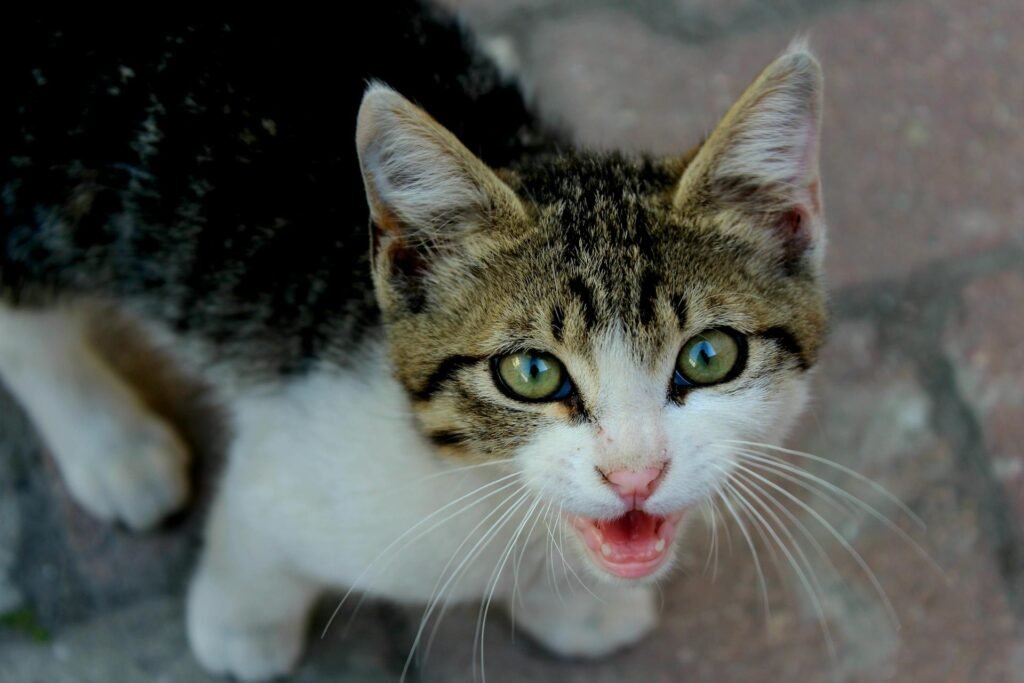
Interestingly, cats rarely meow at other cats. This vocalization is almost exclusively reserved for human communication, suggesting it’s an entirely learned behavior developed through observation and reinforcement. Our article about cats and dogs recognizing their names dives deeper into how our pets learn to recognize and respond to specific sounds.
Why Do Cats Mimic Their Owners?
Social Bonding and Attachment
Unlike the solitary hunters of popular imagination, domestic cats have evolved as social creatures capable of forming strong attachments. Mimicry serves as one method of strengthening social bonds. When your cat copies your behavior, they’re speaking your language, participating in your world.
This desire for social connection drives much of their imitative behavior. Cats who have secure attachments to their owners show more interest in observing and copying human actions. Those with anxious or avoidant attachment styles tend to display less mimicry, focusing instead on independent behaviors.
The bond between cat and owner functions similarly to parent-child relationships in many ways. Just as children learn by watching and imitating their parents, cats learn by observing their primary caregivers. This social learning creates a shared understanding and strengthens the emotional connection between you.
Learning and Problem-Solving
Cats are opportunistic learners. If they see you accomplish something desirable, like opening a container of treats or accessing a high shelf, they’ll absolutely attempt to replicate that success. Mimicry becomes a problem-solving tool, a shortcut to achieving goals.
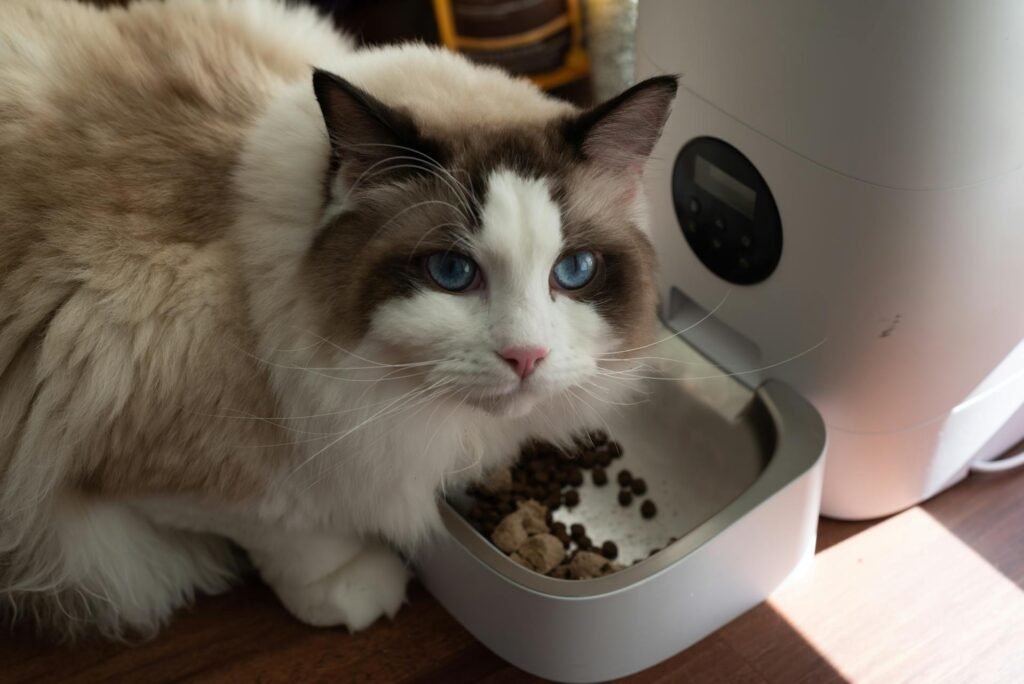
This practical application of imitation shows up in various contexts. Cats learn to open cabinets by watching you do it. They figure out how to navigate cat doors or activate automatic feeders by observing the process. Some even learn to manipulate household members by copying behaviors that successfully manipulate other family members.
One particularly clever example involves food-motivated cats learning to “ask” for treats by sitting in specific locations or performing certain actions, exactly as they’ve seen their owners train dogs to do. They recognize the cause-and-effect relationship and use mimicry to achieve desired outcomes.
Related article: How Often Should You Give Your Cat Treats?
Environmental Adaptation
Cats who mimic their owners adapt more successfully to household life. By copying human routines and behaviors, they integrate themselves into the family structure more effectively. This adaptation reduces stress and creates a more harmonious living situation.
A cat who learns to sleep during nighttime hours (because that’s when their owner sleeps) experiences less nocturnal restlessness and avoids the behavioral issues that come with mismatched schedules.
Similarly, cats who observe and mimic grooming routines, mealtime behaviors, and rest periods establish patterns that align with household norms. This mimicry-based adaptation benefits everyone involved, creating predictable routines and reducing conflicts.
Do Cats Copy Temperament?
One of the most compelling areas of research involves personality synchronization between cats and their owners. Studies have found statistically significant correlations across multiple personality dimensions.
Neuroticism: Owners who score high in neuroticism (experiencing anxiety, mood swings, and emotional volatility) tend to have cats with more behavioral problems. These cats show increased aggression, fearfulness, and stress-related behaviors. The mechanism appears bidirectional: anxious owners create stressful environments, while stressed cats increase owner anxiety.
Extraversion: Social, outgoing owners often have friendlier, more social cats. These felines show less fear of strangers, more playfulness, and greater interest in interactive activities. They’ve learned that social interaction leads to positive outcomes by observing their owner’s social behavior.
Agreeableness: Kind, empathetic owners raise gentler cats. These animals display less aggression, more affectionate behavior, and better tolerance for handling. The calm, positive interactions they observe become their behavioral template.
Conscientiousness: Organized, disciplined owners tend to have cats with fewer behavioral issues overall. Consistent routines, regular feeding schedules, and predictable interactions create stable, well-adjusted cats who mirror that stability in their own behavior.
Openness: Creative, curious owners often have more exploratory, adventurous cats. These felines show greater interest in novel toys, new environments, and varied activities. They’ve learned that curiosity and exploration are safe and rewarding by watching their owner’s approach to new experiences.
This personality mirroring develops gradually through thousands of daily interactions, observations, and learned associations. Your cat becomes socialized into your personality framework, much like how children absorb parental traits.
Comparing Cat and Dog Mimicry
| Aspect | Cats | Dogs |
|---|---|---|
| Social motivation | Lower; more selective about who they imitate | Higher; strong pack mentality drives mimicry |
| Training responsiveness | Learn through observation but selective about compliance | Actively seek to please, making trained mimicry easier |
| Emotional contagion | Present but more subtle; mirror stress and calm | Strong and obvious; quickly adopt owner’s emotional state |
| Vocal mimicry | Adjust meow patterns based on owner responses | Some breeds can mimic human speech patterns |
| Action replication | Capable but selective; must see personal benefit | Enthusiastic; will replicate actions for social reward |
| Independence level | Maintain autonomy even while mimicking | More dependent; mimicry tied to relationship maintenance |
Both species engage in mimicry, but their motivations and methods differ. Dogs evolved as pack animals with hierarchical social structures that prioritize cooperation and following leaders. Cats evolved as semi-solitary hunters who chose to live alongside humans. This fundamental difference shapes how and why they copy us.
Dogs want to please and fit into the pack structure. Cats want to succeed and maintain beneficial relationships. Both use mimicry, but cats apply it more selectively. They’re not interested in copying everything you do, just the things that seem useful, interesting, or socially advantageous.
Recognizing When Your Cat Is Copying You
Sometimes mimicry is obvious. Your cat paws at the door handle the exact way you turn it. Other times, it’s subtle. They’ve started napping in the afternoon because that’s when you take your coffee break.
Watch for timing synchronization first. Does your cat become active when you do? Notice if they adjust their energy levels throughout the day to match yours. Cats who’ve lived with the same owner for years often develop remarkably synchronized daily rhythms.
Pay attention to their problem-solving approaches. When faced with an obstacle, does your cat use techniques similar to how you’d approach it? Some cats develop methodical, step-by-step problem-solving styles that mirror their owner’s approach.
Observe their social behaviors. Has your naturally reserved cat become more outgoing since you’ve been making efforts to socialize more? Conversely, have they become more withdrawn during periods when you’ve been less social? These shifts can reflect emotional mimicry.
Their reactions to new situations can also reveal learned responses. A cat who approaches novel objects with curiosity likely has an owner who models that same openness. One who retreats or shows caution may be mirroring a more anxious owner’s approach to unfamiliar things.
Strengthening the Bond Through Shared Activities
Interactive play sessions where you demonstrate proper use of cat toys can enhance their play skills. Show them how a feather wand works, how a puzzle feeder operates, or how a certain toy makes interesting sounds. Many cats learn faster through observation than through trial and error alone.
Our Guide on how to keep cats entertained while at work offers strategies for cats who’ve become very synchronized with your schedule and struggle when you’re away.
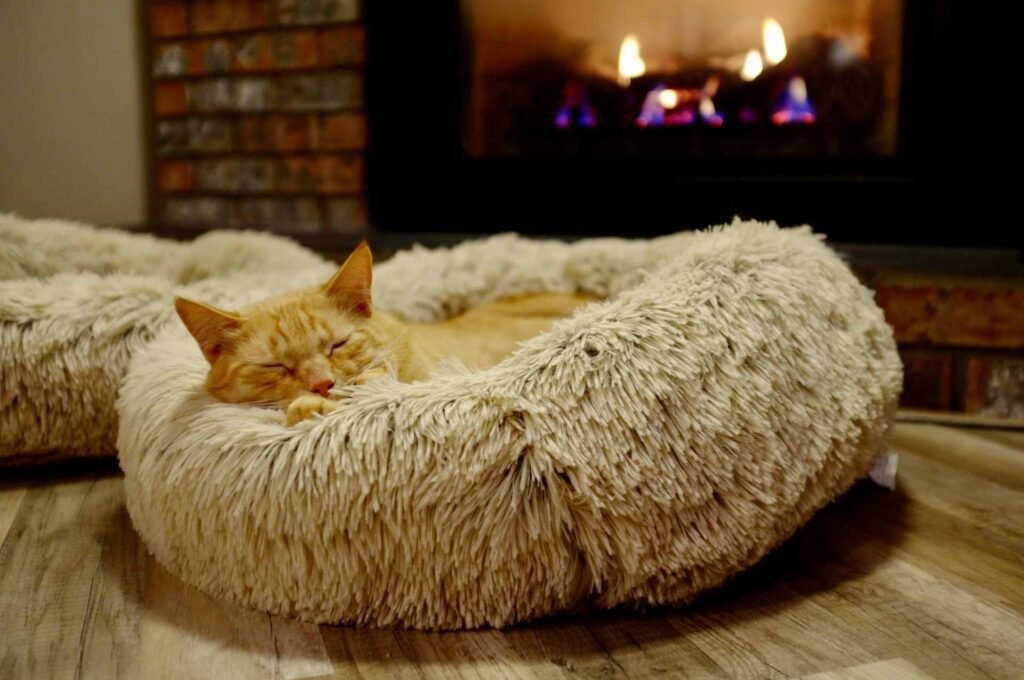
Training becomes more effective when you work with your cat’s natural tendency to observe. Want them to use a specific sleeping spot? Spend time near that spot yourself during rest periods. Hoping they’ll accept a new cat bed? Place it somewhere you frequently sit or sleep.
Grooming routines offer another opportunity. Cats who watch you brush your hair or wash your face often become more accepting of similar grooming activities. If you want to introduce tooth brushing into your cat’s routine, letting them observe you brush your own teeth first can reduce resistance.
Even your responses to stress can be teaching moments. When you model calm problem-solving instead of anxious reactions, you’re teaching your cat that challenges don’t require panic. They absorb these lessons through observation.
Age and Developmental Factors
Kittens show higher rates of mimicry than adult cats, with the most significant social learning occurring between 2 and 7 months of age. During this critical developmental window, they’re absorbing information about how the world works, largely through observation.
What kittens observe during this period shapes their adult personality and behavior patterns. Kittens raised by calm, confident owners in stable environments develop into more secure, adaptable adults. Those experiencing inconsistent care, high stress, or minimal positive interaction often struggle with anxiety and behavioral issues later.
However, mimicry doesn’t stop at adulthood. Adult cats continue learning through observation throughout their lives, though the rate and ease of learning gradually decreases. An older cat might take longer to pick up new patterns than a kitten, but they’re absolutely still capable of learning.
Major life changes can reset some learned patterns. Moving to a new home, adding family members, or experiencing significant schedule shifts all create opportunities for new learning. Cats have to figure out the “rules” of the new situation, and they do this partly through observing how their owner navigates the changes.
Senior cats often show more rigid patterns, having spent years developing and reinforcing certain behaviors. However, with patience and consistency, they can still adapt and learn new responses. Their mimicry might focus more on emotional synchronization and less on physical action replication as they age.
FAQ
Yes, research has confirmed that cats engage in intentional imitation. They observe human actions and deliberately attempt to replicate them, particularly when they perceive a benefit or find the action interesting. This isn’t random mimicry but purposeful social learning involving memory, observation, and motor planning.
No, mimicry varies significantly based on individual personality, breed tendencies, age, and the strength of the cat-owner bond. Highly social, curious cats typically display more imitative behaviors than independent, reserved cats. The amount of time spent observing their owner and the consistency of the owner’s behavior also influence mimicry rates.
Kittens begin observational learning as early as a few weeks of age, though meaningful mimicry of human behaviors typically develops between 2-7 months. Adult cats adopted into new homes may take several weeks to months to establish patterns, depending on their previous experiences and individual personality.
Yes. Cats don’t distinguish between “good” and “bad” behaviors when learning through observation. They simply note what gets results or what patterns their owner follows. Stress responses, irregular sleep schedules, food-related issues, and even aggressive behaviors can all transfer from owner to cat through social learning.
Cats are selective learners who prioritize behaviors that seem useful, rewarding, or necessary for social integration. They’re more likely to copy actions related to food acquisition, accessing desired spaces, social interaction, or solving problems. Random or meaningless (from their perspective) actions get ignored.
In multi-cat households, cats learn from both species, but the type of learning differs. They usually learn cat-specific behaviors (hunting techniques, social signals) from other cats and human-world navigation (door opening, routine following) from people. Neither takes priority universally; it depends on context and individual relationships.
Often, yes. Since cats observe and sometimes copy owner behaviors, modeling calm responses to stress, maintaining consistent routines, and demonstrating gentle interactions can positively influence your cat’s behavior over time. However, some behaviors have other root causes (medical issues, insufficient enrichment) that require different interventions beyond mimicry-based approaches.
Cats likely don’t grasp abstract reasoning behind complex human activities, but they understand cause-and-effect relationships remarkably well. They recognize that certain actions lead to specific outcomes and may copy those actions to achieve similar results, even if they don’t comprehend the full context or purpose behind them.
While cats don’t undergo complete personality transformations, long-term cohabitation does create behavioral synchronization. Anxious owners often see increased anxiety in their cats over time, while calm owners tend to have calmer cats. These changes happen gradually through countless daily interactions and observations, creating what appears to be personality convergence.
Conclusion
Your cat’s been taking notes this whole time. Those long stares while you’re working? They’re studying you. That perfectly timed nap that happens to coincide with your afternoon slump? Not a coincidence. Cats are watching what we do, how we react, and when we do it, then filing that information away for later use.
This mimicry cuts both ways though. If you’re a stress ball, don’t be shocked when your cat turns into one too. If you keep weird hours, expect your cat to develop an equally chaotic schedule. They’re basically holding up a mirror to your lifestyle, and sometimes what reflects back isn’t pretty.
Want a calmer cat? Work on your own stress levels. Hoping they’ll stop knocking stuff over at 3 AM? Fix your own sleep schedule first. You’re the main character in their behavioral instruction manual, whether you signed up for that job or not.
Looking for more? Visit our Blog for more fun and insightful reads, or browse our full Cat Category for everything feline-related, from care to comfort.
Disclaimer: This article is for informational purposes only and does not substitute for professional veterinary advice. Always consult your veterinarian for diagnosis and treatment tailored to your cat’s individual needs. Please verify current product information directly on the retailer’s site before purchasing.
References
- Arahori M, Kimura A, Takagi S, Chijiiwa H, Fujita K, Kuroshima H. Cats Did Not Change Their Problem-Solving Behaviours after Human Demonstrations. Animals (Basel). 2023 Mar 8;13(6):984. https://doi.org/10.3390/ani13060984
- Finka LR, Ward J, Farnworth MJ, Mills DS. Owner personality and the wellbeing of their cats share parallels with the parent-child relationship. PLoS One. 2019 Feb 5;14(2):e0211862. https://doi.org/10.1371/journal.pone.0211862
- Fugazza C, Sommese A, Pogány Á, Miklósi Á. Did we find a copycat? Do as I Do in a domestic cat (Felis catus). Anim Cogn. 2021 Jan;24(1):121-131. https://doi.org/10.1007/s10071-020-01428-6
- Graham C, Koralesky KE, Pearl DL, Niel L. Understanding kitten fostering and socialisation practices using mixed methods. Anim Welf. 2024 Nov 11;33:e52. https://doi.org/10.1017/awf.2024.45
- Grimm, D. (2020). Kitty see, kitty do: cat imitates human, in first scientific demonstration of behavior. https://www.science.org/content/article/kitty-see-kitty-do-cat-imitates-human-first-scientific-demonstration-behavior
- Kilner JM, Lemon RN. What we know currently about mirror neurons. Curr Biol. 2013 Dec 2;23(23):R1057-62. https://doi.org/10.1016/j.cub.2013.10.051
- O’Sullivan, E.P., Caldwell, C.A. (2018). Imitation. In: Vonk, J., Shackelford, T. (eds) Encyclopedia of Animal Cognition and Behavior. Springer, Cham. https://doi.org/10.1007/978-3-319-47829-6_1871-1
- Prato-Previde E, Cannas S, Palestrini C, Ingraffia S, Battini M, Ludovico LA, Ntalampiras S, Presti G, Mattiello S. What’s in a Meow? A Study on Human Classification and Interpretation of Domestic Cat Vocalizations. Animals (Basel). 2020 Dec 14;10(12):2390. https://doi.org/10.3390/ani10122390
- Quaranta A, d’Ingeo S, Amoruso R, Siniscalchi M. Emotion Recognition in Cats. Animals (Basel). 2020 Jun 28;10(7):1107. https://doi.org/10.3390/ani10071107
- Saito A, Shinozuka K. Vocal recognition of owners by domestic cats (Felis catus). Anim Cogn. 2013 Jul;16(4):685-90. https://doi.org/10.1007/s10071-013-0620-4
- Takagi S, Chijiiwa H, Arahori M, Saito A, Fujita K, Kuroshima H. Socio-spatial cognition in cats: Mentally mapping owner’s location from voice. PLoS One. 2021 Nov 10;16(11):e0257611. https://doi.org/10.1371/journal.pone.0257611
- Turner DC. The Mechanics of Social Interactions Between Cats and Their Owners. Front Vet Sci. 2021 Mar 31;8:650143. https://doi.org/10.3389/fvets.2021.650143
- Vitale KR, Behnke AC, Udell MAR. Attachment bonds between domestic cats and humans. Curr Biol. 2019 Sep 23;29(18):R864-R865. https://doi.org/10.1016/j.cub.2019.08.036
Check out our most recent articles!
- Do Cats Copy Their Owners Voice, Personality and Actions?
 The independent cat stereotype is crumbling. Science reveals that cats engage in intentional mimicry, learning from their owners and adapting their personalities to match the humans they live with.
 - Are Newborn Cats Born With Teeth? Everything About Kitten Dental GrowthEver wondered what’s happening inside a newborn kitten’s mouth? The answer might surprise you. Discover the complete timeline of feline dental development and learn what to expect as your kitten grows from gummy grins to a full set of adult teeth.
- Keeping Your Indoor Cat Warm in Winter: The Complete GuideEven indoor cats feel the winter chill more than you might think. Cold floors, dry air, and sneaky drafts can leave your feline less comfortable than they should be. Discover the simple adjustments that make all the difference in helping your cat stay genuinely cozy through the coldest months.
- Should You Look Your Cat in the Eyes? Is Staring Really Aggressive?Your cat’s eyes tell a story you’ve been misreading. While prolonged staring means one thing in human communication, cats interpret it completely differently. Discover why that loving gaze might actually be stressing out your feline friend and what to do instead.
- Choosing the Best Blanket for Your Cat: A Blanket Buyer’s GuideFinding the best blanket for your cat means considering more than just softness. Temperature regulation, durability, washability, and even behavioral quirks all play a role in choosing the perfect cozy spot for your feline friend. Discover which blanket types match your cat’s lifestyle.
- How to Get Your Kitten to Eat More: Simple Solutions for Picky EatersWatching your tiny kitten turn up their nose at perfectly good food can be heart-wrenching. This comprehensive guide reveals why kittens become picky eaters and shares practical solutions that transform mealtime battles into successful feeding routines.
- Can Cats Eat Fried Rice? Why This Takeout Favorite Is a No-GoThat irresistible takeout aroma might have your cat begging, but fried rice contains ingredients that can harm felines. Discover why even small amounts aren’t worth the risk and what treats truly suit your cat’s carnivorous nature.
- Why Do Cats Vibrate Their Tail? From Happy to HuntingYour cat’s vibrating tail is like a mood ring with fur. Whether they’re thrilled to see you or preparing to mark territory, decoding these rapid shakes reveals what’s really going on in their mind.
- Is Asparagus Bad for Cats? Risks, Benefits, and AlternativesYour cat’s eyeing your asparagus dinner, but should they have any? While this green veggie isn’t toxic to cats, there are surprising reasons why it’s not the treat you might think it is.
- How Cats Express Sadness: Reading Your Feline’s Emotional LanguageCats don’t cry emotional tears or mope around like dogs, but they absolutely experience sadness. The trick is learning to read their subtle language, the withdrawn behavior, the changed routines, the slight shifts in body posture that reveal their inner emotional world.
- Can Cats and Rabbits Live Together? Multi-Species Harmony GuideCats are predators, rabbits are prey, but that doesn’t mean they can’t coexist peacefully. Success comes down to understanding each animal’s instincts, respecting their boundaries, and taking introductions at the right pace.
- Are Space Heaters Safe for Cats? Keeping Your Cat CozySpace heaters can provide cozy warmth for your cat, but only when chosen and positioned with feline safety in mind. Discover which features protect against burns, fires, and electrical hazards.
- Cat Bed Placement 101: Finding the Perfect Spot Your Cat Will Actually UseCats spend up to 16 hours sleeping daily, yet many reject their designated beds completely. The problem isn’t pickiness, it’s placement. Learn where cats naturally feel safe and comfortable, and how to position beds they’ll genuinely use.
- Can a Kitten Be Left Alone at Night? What You Need to KnowThose first nights with a new kitten rarely match the peaceful scene you imagined. Learn why most kittens can sleep alone once they reach a certain age, and discover the setup secrets that make nighttime independence work for everyone.
- A Cat’s New Year’s Resolutions: What Your Cat Would Promise (If They Could Write)Cats worldwide are drafting their own new year’s resolutions, and they’re refreshingly honest. From mastering the art of selective hearing to expanding their forbidden food sampling program, discover what your feline friend would promise if they could hold a pen (before knocking it off the desk).















Written by Fenton Harberson (Scientific Writer and Digital Asset Planner)
Last reviewed and edited on 04.03.2026