
If you’ve spent more than five minutes around a cat, you already know the routine. One second they’re zooming across the room like something launched them out of a cannon, and the next they’re completely still, one leg pointed at the ceiling, licking their inner thigh with the calm dedication of a surgeon. No warning. No occasion required.
It raises an interesting question: how do cats know when to clean themselves? Is there an internal schedule we’re not seeing? Is it triggered by something specific? And how do kittens, who start out as helpless little blobs, eventually figure all of this out?
Turns out, there’s a lot going on beneath that sandpaper tongue.
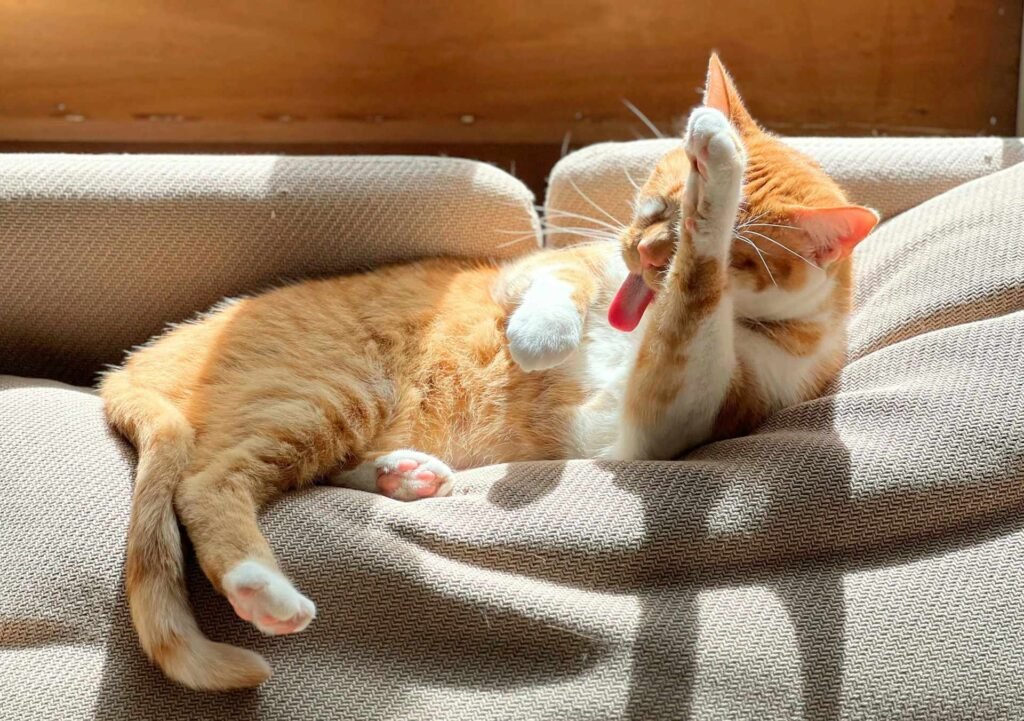
What Sets Off a Grooming Session
Cats don’t groom randomly, even when it looks that way. Their grooming behavior is regulated by a combination of neurological cues, sensory feedback, and biological drives. When a cat’s skin receptors detect a foreign particle, a temperature change, or even a disruption to the natural alignment of their coat, signals are sent to the brain that flag the area for attention.
The most common grooming triggers include:
- After eating: Grooming post-meal is nearly universal. Cats in the wild are ambush predators, and scent masking after a kill likely kept them off the radar of both prey and larger predators. That instinct doesn’t disappear indoors. It just looks like your cat washing their face after finishing their kibble.
- After being touched by a human: This isn’t (necessarily) an insult. When you pet a cat, you displace fur, introduce your scent, and alter the skin temperature in that area. Grooming restores all three to baseline.
- After waking up: Sleep compresses fur and shifts body heat. Grooming after a nap is essentially a reset.
- During or after stress: This is called displacement grooming, and it’s a coping mechanism. A cat who can’t resolve a threat or conflict will often groom instead. It’s a self-soothing behavior rooted in the same neurobiology as comfort-seeking in humans.
What’s remarkable is that cats don’t need to consciously decide to groom. The triggering often happens below the level of deliberate thought, which is why you’ll sometimes catch your cat mid-stretch suddenly pivoting to clean a paw like they had an appointment.
A Lifelong Habit
How Kittens Learn to Clean Themselves
Grooming doesn’t start with the kitten. It starts with the mother. Within minutes of birth, a mother cat begins licking her kittens, stimulating circulation, clearing their airways, and triggering urination and defecation, since newborns can’t do that on their own. That early maternal licking is life-sustaining.
For the first three weeks of a kitten’s life, all grooming comes from mom. Around week three to four, something shifts. Kittens begin making clumsy, uncoordinated attempts at grooming themselves, mostly around the face and paws. They’re not particularly good at it yet, but the motor pattern is already loaded.
By week six or seven, most kittens are grooming themselves with reasonable competence. By week eight, they’re often grooming littermates too, which marks the beginning of allogrooming, a social bonding behavior that continues into adulthood.
When Do Kittens Start Cleaning Themselves?
Most kittens make their first genuine self-grooming attempts between 3 and 4 weeks of age, typically starting with face-washing using their front paws. Full body grooming, including reaching the back and hindquarters, usually comes together between 5 and 8 weeks. Kittens who are orphaned or separated from their mother too early sometimes show delayed or disrupted grooming development, which is worth watching for if you’re bottle-raising a litter. A kitten grooming kit designed for young cats can help if you’re supplementing their care during this period.
The Grooming Order
One of the less-discussed facts about feline grooming is that most cats follow a fairly predictable sequence when they groom themselves. Research into feline grooming behavior has documented a consistent general pattern across the species:
| Stage | Body Area | Notes |
|---|---|---|
| 1 | Face and head | Paws are licked first, then used to wipe the face in circular strokes |
| 2 | Neck and shoulders | Reached directly by tongue |
| 3 | Forelegs and chest | Usually groomed with the tongue and front paw |
| 4 | Flanks and belly | Middle body, sides |
| 5 | Hindlegs and genitals | Requires more flexibility |
| 6 | Tail | Base to tip |
This sequence appears to be driven partly by accessibility and partly by grooming efficiency. The face gets cleaned first because it’s the most contact-prone area during eating, and the paw-lick-then-wipe technique compensates for the fact that a cat can’t directly tongue their own forehead. The rest of the body follows in an order that moves logically from easy-to-reach to requires-a-yoga-pose.
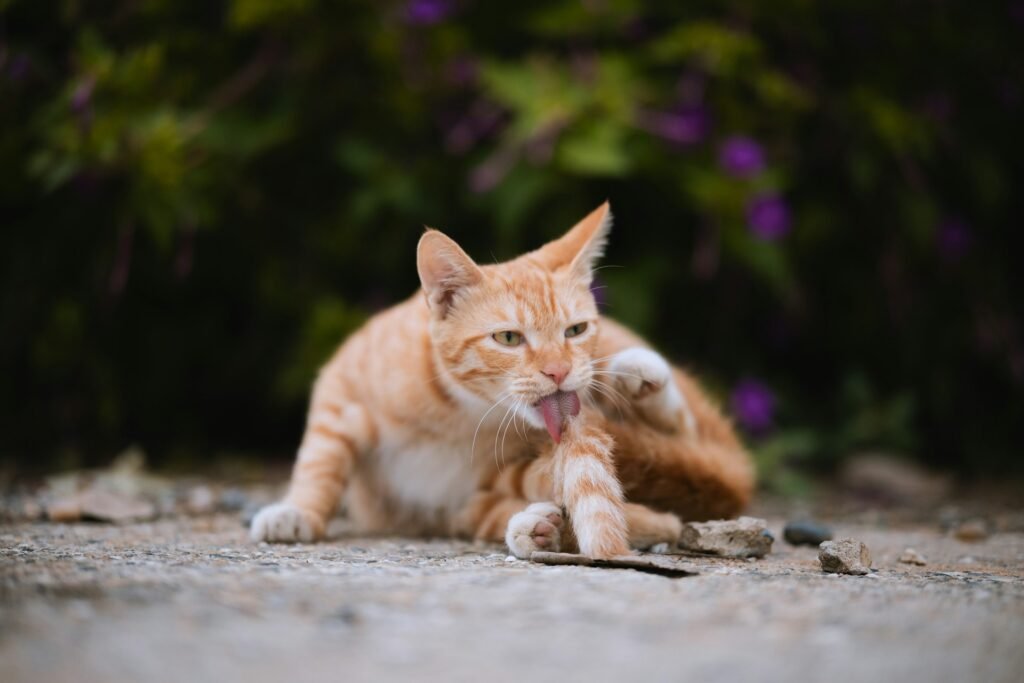
Individual cats will vary, and a cat who skips stages or grooms in a dramatically different order may be dealing with mobility issues, particularly relevant in older cats with arthritis or weight-related flexibility problems.
Do Cats Groom Themselves When They’re Happy?
Yes, but that’s only part of the picture. Grooming is strongly associated with positive, relaxed states. A cat who grooms in your presence, especially in an exposed position (belly up, leg in the air), is communicating a high level of comfort and security. They wouldn’t put themselves in a vulnerable position if they felt threatened.
However, grooming also ramps up during anxiety, boredom, and conflict. The key distinction is context and duration. A relaxed grooming session after a meal or a nap has a loose, fluid quality to it. The cat is unhurried. Stress-triggered grooming tends to be more intense, more localized, and often stops abruptly. Cats who are chronically stressed sometimes develop psychogenic alopecia, hair loss from over-grooming specific areas, usually the belly, inner thighs, or flanks. If your cat is showing bald patches without a clear dermatological cause, it’s worth a vet visit.
Boredom, interestingly, is another common grooming trigger that often gets overlooked. A cat who doesn’t have enough stimulation may groom excessively as a form of self-entertainment. Enrichment, interactive play, and, for indoor cats especially, well-positioned interactive cat toys or puzzle feeders can redirect that restless energy productively.
How Cats Decide Where to Focus Their Grooming
Cats have mechanoreceptors distributed across their skin that respond to pressure, texture changes, and particulate matter. When the coat is disturbed, by contact, static, moisture, or a foreign particle, those receptors send localized signals. The cat then directs grooming attention to that specific zone with remarkable precision.
Additionally, cats use their own sense of smell to identify areas that smell “off.” Cats have an extraordinarily refined olfactory system, and a coat that carries an unfamiliar scent (from another animal, a new environment, or even your perfume) will trigger targeted grooming of that exact spot. This is why cats in multi-pet households sometimes groom each other’s scent off after contact with an unfamiliar animal.
The tongue itself is a precision instrument in this process. A cat’s tongue is covered in hollow, curved keratin spines called papillae, which act like a comb that also delivers saliva deep into the coat. There’s a reason grooming tools modeled after cat tongue texture, like certain deshedding brushes with flexible curved tines, have become popular for mimicking what cats do naturally.
The Social Side: Allogrooming
Cats who live together and have a positive relationship will often groom each other, a behavior called allogrooming. This almost always focuses on the head, face, and neck: areas the recipient can’t easily reach themselves. It functions as both practical hygiene and social bonding, and the direction tends to flow from the more confident cat to the more submissive one, though this isn’t a rigid rule.
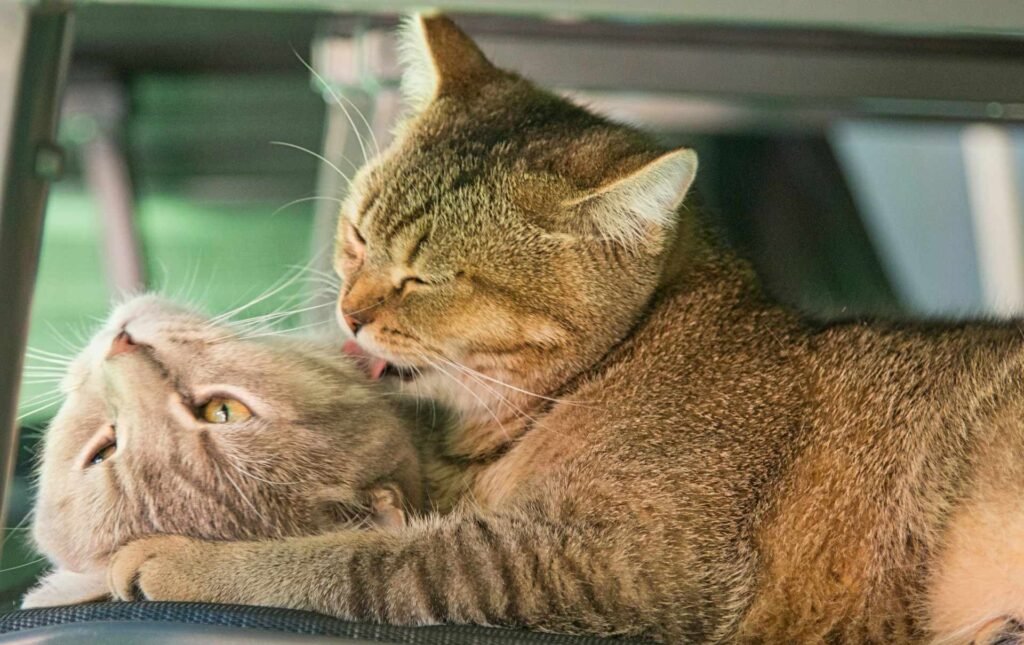
What’s notable is that cats who allogroom each other tend to have lower rates of conflict within the household. It’s sort of a social investment. If your cats engage in mutual grooming, that’s a good sign about the relationship, possibly better than how much they tolerate each other during meals.
Some cats extend allogrooming to their humans, particularly licking hair or exposed skin. Whether this is affection, scent adjustment, or your cat genuinely thinking you’re terrible at self-care is an open debate, but it’s generally considered a sign of close bonding. And if you’ve noticed that your cat seems to read your moods and behavior more closely than you’d expect, you’re not imagining the connection.
When Grooming Habits Change
A cat who suddenly grooms significantly more or significantly less than usual is often flagging something worth investigating. Here’s a quick breakdown:
Over-grooming (Hyperesthesia or Psychogenic Alopecia)
- Bald patches, usually symmetrical
- Excessive licking of one specific location
- May indicate allergies, parasites, pain in the area, or anxiety
- Flea allergy dermatitis is one of the most common culprits, one flea bite can trigger a cascade in sensitive cats
Under-grooming (Matting, Dull Coat, Odor)
- Often a sign of pain (arthritis, dental pain), illness, obesity (can’t reach areas), or depression
- Older cats especially may need grooming assistance, a soft-bristle grooming glove can make this easier and more comfortable for them
- A cat with dental pain may stop face-washing because licking causes discomfort
It’s worth noting that a cat’s coat condition is one of the most reliable external indicators of their overall health. A cat who looks well-groomed is usually also eating, moving, and feeling reasonably well. A coat that suddenly looks unkempt, greasy, or patchy is often the first visible sign that something has shifted, and a vet visit is the right next step.
On the hygiene side of things, grooming does a lot, but it doesn’t do everything. Your cat’s food and water bowls, for example, carry bacteria that affect skin and coat health in ways that grooming can’t fix. Same goes for their sleeping area, a clean, well-chosen bed carries a lot of weight.
FAQ
When you stroke your cat, you deposit your scent, shift fur alignment, and change the skin temperature in that area. Your cat’s grooming is a reset. They’re restoring their coat to the condition and scent profile they prefer. It’s not rejection.
Yes. Adult cats spend anywhere from 30% to 50% of their waking time grooming. For a cat who sleeps 12 to 16 hours a day, that leaves a relatively modest window, and a significant chunk of it goes to coat care. As long as the coat looks healthy and there are no bald patches, extended grooming is completely normal.
Actually, they often stop. Pain, particularly arthritis, dental disease, or internal discomfort, frequently causes a decline in grooming. If your cat’s coat is becoming unkempt and they’re an older animal or have a health history, pain management should be explored with your vet.
This is a deep ancestral holdover. Wild cats groom post-feeding to remove scent traces that could attract competitors or alert future prey. Your indoor cat doesn’t need to do this strategically, but the neurological trigger remains fully intact. Think of it as their version of washing their hands after a meal.
Yes. Psychogenic alopecia is a real condition where stress or anxiety drives a cat to groom compulsively, often creating raw, bald patches on the belly, inner thighs, or flanks. Environmental stressors, multi-pet conflicts, and major household changes are common triggers. A vet can rule out dermatological causes and discuss behavioral or pharmaceutical support if needed.
Not from birth, that starts a few weeks in. By around 4 to 5 weeks, kittens begin attempting to groom littermates, mostly around the face and ears. By 8 weeks, mutual grooming is a regular social activity within the litter. Kittens raised in isolation sometimes show less refined allogrooming behavior as adults.
Absolutely, especially for seniors, overweight cats, or long-haired breeds. Mats can form quickly in areas cats can’t reach, and those mats can become painful and even lead to skin infections underneath. A wide-toothed comb or detangling brush used gently a few times a week can prevent most issues before they start.
Pretty much, yes. Most cats follow a head-to-tail sequence that starts with face-washing using the paw-wipe technique and ends with the tail. This appears to be instinctive rather than learned, since kittens raised without observing other cats still develop the same general sequence.
Probably both. Cats who lick their owners, particularly focusing on hair or hands, are almost certainly engaging in allogrooming, which is a bonding behavior they reserve for cats they trust. There may also be a scent-adjustment element at play, but at its core, it’s social. You’ve been accepted into the inner circle.
The Bigger Picture
It’s impressive how a cat manages its own body. No shampoo, no appointment, no assistance required for the vast majority of their lives. The system they’ve evolved is efficient, multi-functional, and so deeply wired that it begins within hours of birth and runs continuously until the end of their life.
Knowing what drives grooming, when it starts in kittens, what triggers it in adults, and when a change in grooming frequency signals something worth investigating, makes you a sharper observer of your cat’s wellbeing. And frankly, it gives you a lot more to think about the next time you catch them doing the ceiling-leg maneuver on the couch.
If grooming has you curious about other aspects of your cat’s daily routine and physical quirks, you might enjoy reading about what your cat’s sleeping positions actually communicate, there’s more information in those little curled-up poses than you think.
Your cat already knows exactly what they’re doing. Now, so do you.
Looking for more? Explore our Cat Hygiene section for more posts like this, visit the Blog for fun and insightful reads, or browse our full Cat Category for everything feline-related, from care to comfort.
Disclaimer: This article is for informational purposes only and does not substitute for professional veterinary advice. Always consult your veterinarian for diagnosis and treatment tailored to your cat’s individual needs. Please verify current product information directly on the retailer’s site before purchasing.
References
- A.C. Noel, & D.L. Hu, Cats use hollow papillae to wick saliva into fur, Proc. Natl. Acad. Sci. U.S.A. 115 (49) 12377-12382, https://doi.org/10.1073/pnas.1809544115 (2018).
- Banks PB, Daly A, Bytheway JP. Predator odours attract other predators, creating an olfactory web of information. Biol Lett. 2016 May;12(5):20151053. https://doi.org/10.1098/rsbl.2015.1053
- Crowell-Davis SL, Curtis TM, Knowles RJ. Social organization in the cat: a modern understanding. J Feline Med Surg. 2004 Feb;6(1):19-28. https://doi.org/10.1016/j.jfms.2003.09.013
- Curtis TM, Knowles RJ, Crowell-Davis SL. Influence of familiarity and relatedness on proximity and allogrooming in domestic cats (Felis catus). Am J Vet Res. 2003 Sep;64(9):1151-4. https://doi.org/10.2460/ajvr.2003.64.1151
- Eckstein RA, Hart BL. The organization and control of grooming in cats. Appl Anim Behav Sci. 2000 May 10;68(2):131-140. https://doi.org/10.1016/s0168-1591(00)00094-0
- International Cat Care (2025). Over-grooming in cats. https://icatcare.org/articles/over-grooming-in-cats
- Looft FJ. Response of cat cutaneous mechanoreceptors to punctate and grating stimuli. J Neurophysiol. 1986 Jul;56(1):208-20. https://doi.org/10.1152/jn.1986.56.1.208
- Veronesi MC, Fusi J. Feline neonatology: From birth to commencement of weaning – what to know for successful management. J Feline Med Surg. 2022 Mar;24(3):232-242. https://doi.org/10.1177/1098612X221079709
- Waisglass SE, Landsberg GM, Yager JA, Hall JA. Underlying medical conditions in cats with presumptive psychogenic alopecia. J Am Vet Med Assoc. 2006 Jun 1;228(11):1705-9. https://doi.org/10.2460/javma.228.11.1705
Check out our most recent articles!
- How Cats Always Know Exactly Where (and When) to Groom
 A cat who suddenly grooms less isn’t being lazy. One who grooms constantly might not just be clean-obsessed. Grooming habits are one of the clearest windows into your cat’s wellbeing once you know what to look for.
 - Why Do Cats Push Things Off Tables? Solving Your Cat’s Destructive HabitCats knock things off tables due to hunting instincts, boredom, and attention-seeking behavior. Discover the science behind this maddening habit and learn practical prevention strategies that actually work.
- Can Cats Eat Green Peas? Safe, Healthy, or Just a Skip?A pea rolling across the kitchen floor is basically a free cat toy and a snack in one. But before it becomes a habit, here’s what you should know about what those little green things actually do for (or to) your cat.
- Are Spray Bottles Bad for Cats? Reasons & AlternativesA spray bottle might stop your cat’s counter-surfing today, but it’s teaching them something much more troubling: that you’re unpredictable and potentially dangerous. Discover what really happens when you spray your cat and the alternatives that actually create lasting change.
- How Are Cats so Flexible? Your Cat’s Anatomy ExplainedBetween their 53 vertebrae, muscular shoulders connected only by soft tissue, and elastic joints, cats possess anatomical superpowers that blur the line between solid and liquid, letting them navigate spaces you’d swear were too small.
- Do Cats Copy Their Owners Voice, Personality and Actions?The independent cat stereotype is crumbling. Science reveals that cats engage in intentional mimicry, learning from their owners and adapting their personalities to match the humans they live with.
- Are Newborn Cats Born With Teeth? Everything About Kitten Dental GrowthEver wondered what’s happening inside a newborn kitten’s mouth? The answer might surprise you. Discover the complete timeline of feline dental development and learn what to expect as your kitten grows from gummy grins to a full set of adult teeth.
- Keeping Your Indoor Cat Warm in Winter: The Complete GuideEven indoor cats feel the winter chill more than you might think. Cold floors, dry air, and sneaky drafts can leave your feline less comfortable than they should be. Discover the simple adjustments that make all the difference in helping your cat stay genuinely cozy through the coldest months.
- Should You Look Your Cat in the Eyes? Is Staring Really Aggressive?Your cat’s eyes tell a story you’ve been misreading. While prolonged staring means one thing in human communication, cats interpret it completely differently. Discover why that loving gaze might actually be stressing out your feline friend and what to do instead.
- Choosing the Best Blanket for Your Cat: A Blanket Buyer’s GuideFinding the best blanket for your cat means considering more than just softness. Temperature regulation, durability, washability, and even behavioral quirks all play a role in choosing the perfect cozy spot for your feline friend. Discover which blanket types match your cat’s lifestyle.
- How to Get Your Kitten to Eat More: Simple Solutions for Picky EatersWatching your tiny kitten turn up their nose at perfectly good food can be heart-wrenching. This comprehensive guide reveals why kittens become picky eaters and shares practical solutions that transform mealtime battles into successful feeding routines.
- Can Cats Eat Fried Rice? Why This Takeout Favorite Is a No-GoThat irresistible takeout aroma might have your cat begging, but fried rice contains ingredients that can harm felines. Discover why even small amounts aren’t worth the risk and what treats truly suit your cat’s carnivorous nature.
- Why Do Cats Vibrate Their Tail? From Happy to HuntingYour cat’s vibrating tail is like a mood ring with fur. Whether they’re thrilled to see you or preparing to mark territory, decoding these rapid shakes reveals what’s really going on in their mind.
- Is Asparagus Bad for Cats? Risks, Benefits, and AlternativesYour cat’s eyeing your asparagus dinner, but should they have any? While this green veggie isn’t toxic to cats, there are surprising reasons why it’s not the treat you might think it is.
- How Cats Express Sadness: Reading Your Feline’s Emotional LanguageCats don’t cry emotional tears or mope around like dogs, but they absolutely experience sadness. The trick is learning to read their subtle language, the withdrawn behavior, the changed routines, the slight shifts in body posture that reveal their inner emotional world.














Written by Fenton Harberson (Scientific Writer and Digital Asset Planner)
Last reviewed and edited on 05.04.2026